How can 618 houses built from a single set of blueprints sell for prices that differ by hundreds of thousands of dollars?
Ridge at the Bluffs comes about as close as residential real estate gets to a controlled experiment. DiVosta built all 618 homes in the subdivision in 1985 from one floor plan: three bedrooms, two baths, 1,889 square feet under air, concrete block construction, vaulted ceilings, a two-car garage, and a walled courtyard on a zero lot line. The amenity package is shared too, a community pool, tennis and basketball courts, no gate, and low HOA dues. The only officially acknowledged variation between houses is roof style and exterior paint color. Every buyer here is buying the same base product.
And yet one house in Ridge at the Bluffs recently sold for $1.65 million, while a nearly identical unit a few streets over listed under $1 million and needed work before anyone would call it move-in ready. If the architecture is fixed and the amenities are shared, something else in this neighborhood is setting the price.
The Wider Bluffs Number Hides More Than It Shows
Ridge at the Bluffs, sometimes labeled Bluffs Ridge on MLS sheets, is one of seven subdivisions inside the larger Bluffs community, alongside Bluffs River, River North, The Lakes, The Marina, and the oceanfront Ocean North and Ocean South condo towers. Over the twelve months ending in April 2026, the entire Bluffs community recorded 117 home sales, with an average asking price of $752,605 and an average selling price of $710,174, a 94 percent list-to-sell ratio, roughly $386 per square foot, and an average of 126 days on market.
That figure is accurate and it describes almost nothing you'd actually buy. It blends 1985 concrete cottages a third of a mile from the sand with Intracoastal-front houses carrying private docks, plus two-bedroom marina condos priced on boat slip views. Average all of that together and the number fits none of them individually. Anyone shopping Ridge at the Bluffs specifically is comparing against a yardstick built from a different set of homes entirely.
What Happens When You Actually Hold the House Constant
Zoom into Ridge at the Bluffs alone and the spread doesn't shrink. It stays enormous, even with every house starting from the identical 1,889-square-foot DiVosta plan.
| Location | Status | Price | What changed from the base plan |
|---|---|---|---|
| Ridge Road | Sold, 2026 | $1,650,000 | Expanded to 2,079 sq ft |
| Dunes Edge Road | Active | $1,349,000 | Craftsman-style renovation, loft converted to a fourth bedroom |
| Ridge at the Bluffs (new listing) | Active, original condition | $990,000 | Base 1,889 sq ft plan, described as needing a buyer's "personal touch" |
That's a spread of roughly $660,000 across three homes that all began as the same subdivision, same builder, same year, same floor plan. The blueprint isn't producing that gap. Something layered on top of it is.
Three Things Actually Doing the Pricing
Lot position, not floor plan. Some Ridge lots back directly onto the protected dunes, buying a kind of privacy no interior renovation can add. DiVosta also reserved four larger, custom-built homes for the Ridge Road cul-de-sac closest to the beach, the tightest, most walkable stretch in the subdivision. An interior lot on a through street is a different asset than a dune-backed lot on a dead end, even with an identical house sitting on top of both.
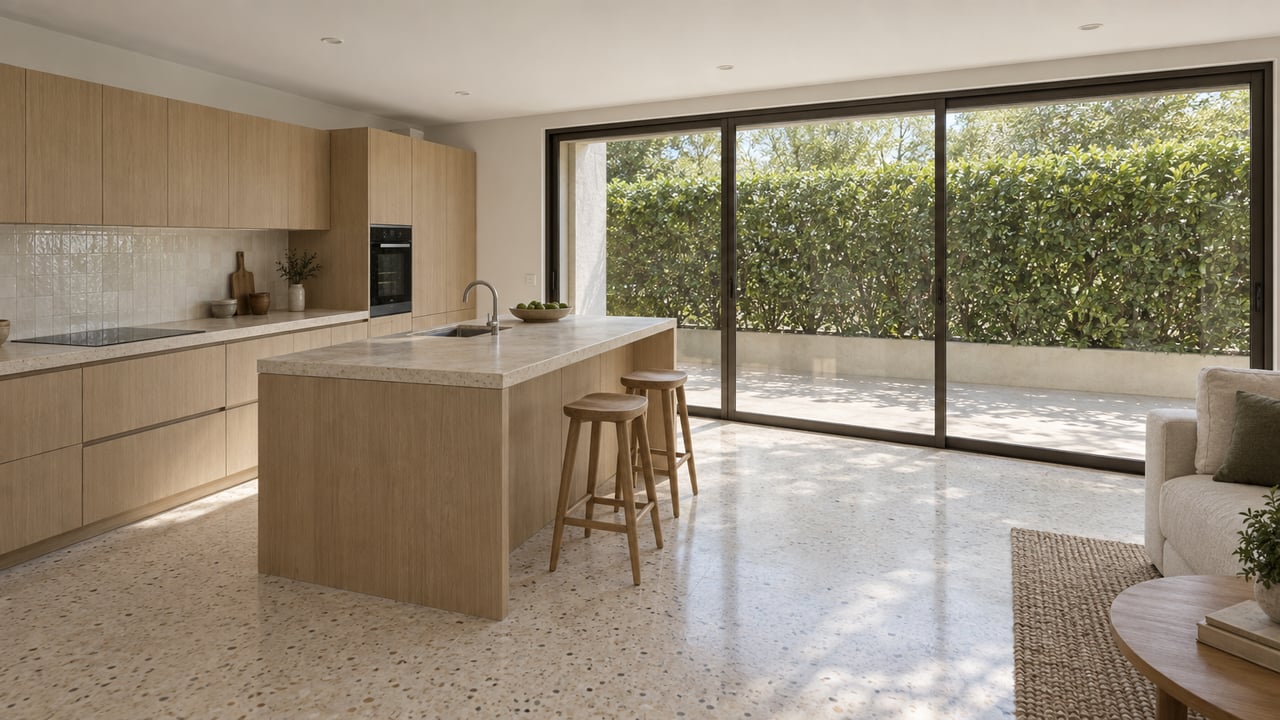
How much of 1985 survived. Some owners have never touched the original galley kitchen. Others have gutted the house to the slab, added impact glass, converted the loft above the vaulted living room into a fourth bedroom, and replaced the roof. A comp sheet that reads "1,889 square feet, built 1985" can describe either one, and the buyer has no way to know which without walking the property.
The zero-lot-line design cuts both ways. Walled courtyards make these homes close to maintenance-free, which changes the weekly yard-work math compared to a standard quarter-acre lot. The same wall means sightlines to the neighboring house differ sharply depending on which side of the property the courtyard faces, so two houses on the identical plan can feel completely different in how much privacy they deliver.
The Name Promises a View It Doesn't Deliver
The subdivision sits on some of the highest residential elevation in South Florida, high enough that the developer named the whole community after it. That elevation buys ocean breeze, not ocean view. The single-family homes in Ridge at the Bluffs don't face the Atlantic. That sightline belongs to Ocean North and Ocean South, the two Bluffs subdivisions built directly on the beach side of A1A. Anyone picking a lot in Ridge at the Bluffs expecting a water view because of the name is pricing in something the house was never built to deliver.
For Sellers, the Same Math Runs in Reverse
If you already own one of these homes and are weighing whether to renovate before listing, the comparison above is worth sitting with. The jump from the original-condition listing at $990,000 to the renovated version at $1,349,000 is roughly $360,000, and the square footage barely moved. In a neighborhood where every house started identical, a renovation's return is easier to isolate than in a community where every house was already different from its neighbor to begin with. That's useful information before committing to a kitchen gut or a loft conversion.
What This Means If You're Comparing Jupiter Neighborhoods
Anyone cross-shopping Ridge at the Bluffs against a neighborhood with more architectural variety, custom-home communities in Tequesta or the mixed inventory of Jupiter Inlet Colony, will be tempted to compare medians and call the research done. Ridge at the Bluffs argues against that shortcut from the inside. Even where the product is genuinely uniform, the number that lands on the closing statement depends on lot position, renovation depth, and how the courtyard wall happens to sit relative to the neighbor's. A subdivision median tells you almost nothing about which specific house you'd be buying.
FAQ
Why do square footage numbers vary if every house started with the same plan? Additions change the number. A loft conversion into a fourth bedroom or an enclosed Florida room adds space under air that the original 1985 plan didn't include, which is why some listings show 1,889 square feet and others show over 2,000.
Does an interior lot mean a worse deal? Not automatically. Interior lots trade dune-backed privacy for a shorter walk to the community pool and tennis courts, and the walled courtyard design controls sightlines either way. The tradeoff depends on what a buyer is weighing, not a guaranteed price penalty.
If you're weighing a purchase in Ridge at the Bluffs, or trying to figure out whether a listing's price reflects the lot, the renovation, or an optimistic asking number, The Bradley Group can pull the specific comps that actually match what you're looking at instead of a subdivision-wide average that's blending in houses you're not buying.