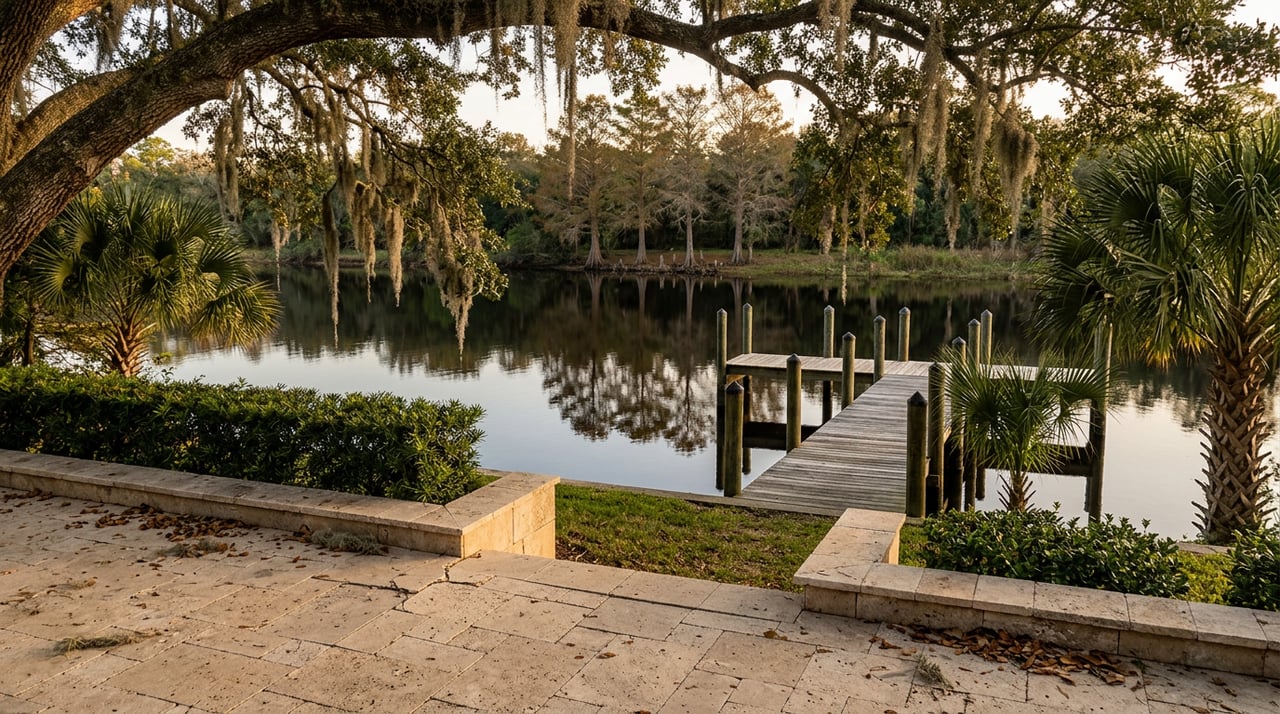
Stand on a dock in Heritage Oaks in mid-September and the North Fork looks like it always does this time of year: warm, quiet, tannin-dark under the oak canopy, with maybe a mullet jumping and not much else. Ask a longtime resident when the manatees show up and most will say "around Thanksgiving" or "some time in winter." That answer isn't wrong, but it isn't the real trigger either. The manatees aren't watching a calendar. They're watching a number, and once that number crosses a threshold, the river outside your window changes character within days, not months.
That distinction matters if you live on this stretch of the Loxahatchee, because Heritage Oaks sits in an unusual spot on the map. The community's roughly 200 homes run along the North Fork under a canopy of mature oaks, and the neighborhood backs directly onto land adjacent to Jonathan Dickinson State Park, the same park that holds the stretch of river that earned the Loxahatchee its status as Florida's first federally designated Wild and Scenic River back in 1985. A gated, guard-manned community with tennis courts and manicured lots is also, by simple geography, next door to one of the most protected river systems on this coast. That combination is rare, and it means the wildlife calendar here isn't an abstraction from a nature brochure. It plays out a few feet from the seawall.
The Two Mammals That Actually Live Here
Most people default to alligators and manatees when they think about Loxahatchee wildlife, but the U.S. Fish and Wildlife Service's own designation of the river names something more specific: the two mammals that regularly frequent the Loxahatchee are the West Indian manatee and the river otter. Otters rarely make the conversation, probably because they're harder to spot and don't draw crowds the way a manatee does, but they're a genuine year-round presence along this river, not a rare sighting worth a phone call to the neighbors.
Alligators are the third animal residents ask about, and the honest answer is that seeing one in the fresher upstream stretches of the North Fork is normal, not a sign anything is wrong. It's a reason to keep dogs out of that water rather than a reason for alarm, and it's consistent with how this river has always worked. The upper Loxahatchee is one of the best remaining examples of a south Florida river-swamp, and river-swamps come with alligators the way beaches come with sand.
What Actually Triggers the Manatees
Here's the part that generic "wildlife guide" content tends to flatten into a single line: manatees don't arrive because it's November. They arrive because the water drops below about 68 degrees, and that threshold can hit weeks earlier or later than any generic seasonal guide suggests, depending on the weather that particular year.
The clearest recent demonstration of how fast this can happen came from Manatee Lagoon in Riviera Beach, about thirty minutes south along the same Palm Beach County coastline. On January 29, 2026, a single cold front pushed manatee sightings there to 160 in one morning, the highest count of that entire season, as the animals abandoned the cooling ocean for the nearest reliable warm water. That's not a seasonal drift. That's an animal responding to a specific weather event within hours.
The same mechanism works on the Loxahatchee. Closer to the river's mouth, an area called Cato's Bridge near the Jupiter Inlet has become a known local gathering spot precisely because manatees are drawn to the freshwater outflow where the river meets the Intracoastal. Heritage Oaks sits farther upstream on the North Fork, so the crowds and the snorkel charters stay down near the inlet. But the same federal designation that names the manatee as a regular river visitor doesn't restrict that visit to the mouth. The animals move through the system, and a stretch of river shaded by oak canopy and buffered from boat traffic is exactly the kind of quiet water they favor once they're up here.
What this means practically: the reliable window for increased manatee activity on this stretch runs from roughly mid-November through March, but the actual start date each year is set by the first hard cold front, not by a page on a calendar. Residents who want to know when to start watching the water more closely are better served checking a weather forecast for the season's first real cold snap than marking a date in advance.
The Calendar That Does Matter: What's Happening Upstream
If the wildlife calendar runs on temperature, the human calendar around it is more predictable, and it happens to bookend the same season almost exactly. A few minutes upriver at Riverbend Park, three recurring events give residents actual reasons to get in the car or on the water during the exact months the river is busiest:
- Early November — Riverbend Park hosts its Farmstead heritage event on the first Saturday of the month, right as the season's first cold fronts start arriving and the manatee window opens.
- Late January — the park holds its Second Seminole War battlefield reenactment on the last Saturday of the month, landing squarely in the coldest, highest-activity stretch of manatee season.
- March — the annual 5K Green Run takes place at Riverbend Park, timed to roughly when manatee sightings on the coast start thinning out again as water temperatures climb.
None of these events are about manatees directly, but their placement on the calendar traces the same arc as the wildlife season almost exactly. A resident who shows up to the Farmstead event in November and the battlefield reenactment in January is, without planning it that way, bookending the exact window when the North Fork is doing the most.
| What people assume | What actually happens |
|---|---|
| Manatees arrive "in winter," roughly on schedule | Manatees arrive when water drops below about 68°F, which can shift by weeks year to year |
| Alligators showing up means something changed | Alligators in the fresher upper river are a constant, not an event |
| The manatee show happens at the inlet, not upstream | The same federal designation names manatees as regular river visitors throughout the system, including quieter upstream stretches |
Why This Is Worth Knowing If You Already Live Here
None of this changes what Heritage Oaks is. It's still an oak-canopied, guard-gated community with a mix of river and lake lots, and it's still one of the few places in Tequesta where a private dock backs onto genuinely protected water rather than a canal cut for development. But knowing that the river's wildlife runs on a thermometer rather than a calendar changes how you use your own backyard. It means the first serious cold front of the season, not the first day of November, is the signal worth watching. It means the otters gliding past your seawall in July are as much a part of this river's identity as the manatees everyone waits for in January. And it means the quiet stretch of the North Fork behind your house is connected to the exact same system that draws boat traffic and snorkel charters down at the inlet, just without the crowds.
For anyone who ends up talking to friends or family about what it's actually like to live along this part of the river, or who starts wondering what a home like this is worth given how much of its value sits in that river frontage, that's a conversation worth having with someone who knows this stretch of water as well as the market around it.
If you want that conversation, The Bradley Group has spent years working this exact corner of Tequesta and Northern Palm Beach County, and Bradley Hurst is always glad to talk through what a property on the North Fork is actually worth in today's market. Reach out any time for a free home valuation, no obligation, just a straight answer from someone who watches this river as closely as you do.